Query the moment data arrives. At any scale, across any data type.
Ingest 1 million values per second, then query the results instantly with millisecond response times. Standard SQL, one database.
Traditional databases were not built for data that never stops moving. CrateDB is. One distributed SQL engine for real-time ingestion, sub-second analytics, and AI queries. No batch pipelines. No fragmented stacks.
Watch the 90-second overview: from high-volume ingestion to sub-second query results.
From high data ingestion to advanced querying in milliseconds. Any data, any scale, with SQL.
See it for yourself
Through a series of guided steps, we walk you in under 30 minutes from setup to dashboards.
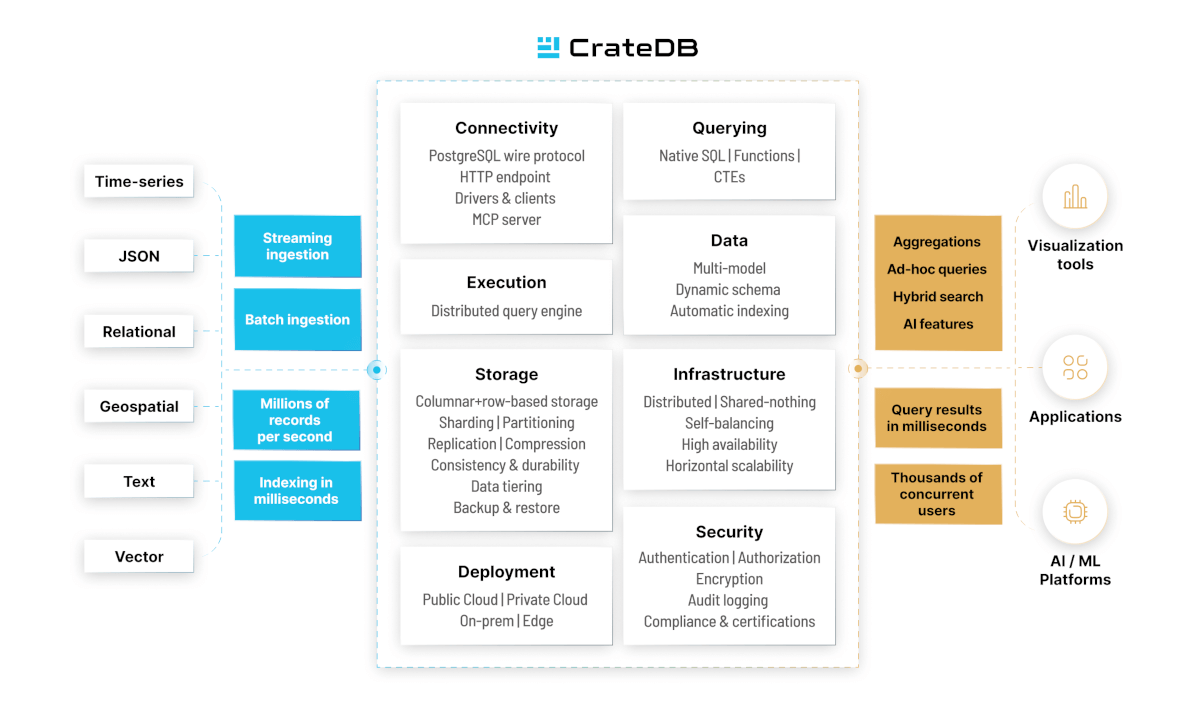
Architecture overview Built for Real-Time Analytics, Search, and AI Workloads
Time series data captures how values change over time, like sensor readings, metrics, or events. It enables trend analysis, monitoring, and real-time insights based on when data happened, not just what happened. Learn more >
JSON data stores flexible, semi-structured information using key–value pairs. It lets applications evolve their data model easily while still enabling fast filtering, aggregation, and analytics. Learn more >
Relational data is structured into tables with defined columns and relationships. It provides consistency, clear schemas, and powerful querying for reliable analytics and business reporting. Learn more >
Geospatial data represents locations and shapes on the Earth, such as points, lines, and areas. It enables distance calculations, spatial filtering, and location-based analytics. Learn more >
Text data captures unstructured information like logs, messages, or descriptions. It enables search, filtering, and pattern detection across large volumes of human-readable content. Learn more >
Vector data represents information as numerical embeddings that capture semantic meaning. It enables similarity search, recommendations, and AI-driven retrieval beyond exact keyword matching. Learn more >
Streaming ingestion continuously captures and processes data as it arrives. It enables real-time analytics on fresh data without waiting for batch processing. Learn more >
Batch ingestion loads data in scheduled chunks rather than continuously. It is well suited for historical backfills, periodic updates, and large-volume data imports. Learn more >
High throughput: CrateDB can ingest extremely high data volumes in real time. It can keep up with large-scale event streams without sacrificing query performance. Learn more >
Auto-indexing in milliseconds: Data becomes queryable almost immediately after ingestion. This allows analytics and search to run on fresh data with minimal latency. Learn more >
Connectivity: Multiple access options let applications connect easily, including the Postgres wire protocol, HTTP endpoints, native drivers and clients, and MCP servers. Learn more >
Execution: Queries are executed in parallel across multiple nodes. This enables fast analytics and predictable performance as data volume and workload scale. Learn more >
Storage: CrateDB combines columnar and row-based storage with sharding, partitioning, and replication to scale reliably. Built-in compression, consistency, data tiering, and backup and restore ensure durable data management. Learn more >
Deployment: CrateDB runs consistently across public cloud, private cloud, on-premises, and edge environments. This lets teams deploy analytics close to their data while keeping the same architecture and capabilities everywhere. Learn more >
Querying: CrateDB uses native SQL with built-in functions and CTEs to express complex analytics clearly. Teams can query real-time and historical data using familiar, powerful constructs. Learn more >
Data: CrateDB supports multi-model data with a dynamic schema that adapts as data evolves. Automatic indexing ensures new data is queryable immediately without manual tuning. Learn more >
Infrastructure: A distributed, shared-nothing architecture spreads data and workloads across nodes. Self-balancing, high availability, and horizontal scalability ensure resilient performance as the system grows. Learn more >
Security: CrateDB provides authentication and authorization controls to manage access safely. Encryption, audit logging, and compliance certifications help protect data and meet regulatory requirements. Learn more >
Analytics & AI: CrateDB supports fast aggregations and ad-hoc queries on live data. Hybrid search and built-in AI features enable deeper insights, from exploration to intelligent applications. Learn more >
Query results in milliseconds: Queries return results with very low latency, even on large datasets. This enables interactive analytics and real-time decision-making.
Thousands of concurrent users: The system handles many users and applications querying data at the same time. Performance remains stable even under high concurrency.
Visualization tools: CrateDB integrates with popular BI and visualization tools using SQL. This makes it easy to explore data, build dashboards, and share real-time insights.
Applications: CrateDB powers real-time applications built on fresh, high-volume data using SQL. It supports analytics-driven features, operational dashboards, and AI-enabled user experiences.
AI and ML platforms: CrateDB integrates with AI and machine learning platforms using SQL to feed models with fresh, high-volume data. This supports RAG, recommendations, anomaly detection, and real-time inference.
"We needed a solution that could watch, record and analyze production in real time. CrateDB gives us the freedom to be cumulative and scale limitless - we found no alternative solution with such simplicity and efficiency.”
"Working with CrateDB brings positive outcomes. The ingestion and throughput have very good performance, with 1 million values/sec, the horizontal scalability where we can add as many nodes as we need and the automatic query distribution across the whole cluster."
"CrateDB allows us to do real-time dashboards on very big streaming and historic datasets in a simple way. We can scale the system easily as we grow the load and customers and have it all done with SQL." Read the Bitmovin customer story
"Having a standardized SQL language is a big advantage with CrateDB. That makes it very easy for people to access this data and work with it in different tools like Grafana or Tableau."