An analytics database is a database system designed to efficiently analyze large volumes of data using complex queries, aggregations, and filters. Unlike transactional databases built for individual record updates, analytics databases are optimized for reading and processing data at scale across historical and real time datasets.
Analytics databases power dashboards, operational reporting, and data driven applications across industries. They are used to identify trends, monitor performance, and support decision making where speed and flexibility matter. As data volumes grow and analytics moves closer to production systems, the role of the analytics database has become a core component of modern data architectures.
This article explains what an analytics database is, how it works, the problems it solves, and how it compares to other database technologies such as transactional databases and data warehouses.
What Is an Analytics Database?
Rather than focusing on transactional workloads, analytics databases are designed to efficiently answer questions across large datasets. They excel at scanning, aggregating, and correlating data, enabling users to explore patterns and trends across both historical and continuously ingested data.
In practice, analytics databases are commonly used to:
- Analyze trends and patterns
- Power dashboards and reports
- Support operational and real-time decision making
- Feed downstream systems such as machine learning models
To support these use cases, analytics databases prioritize read performance, horizontal scalability, and query efficiency over high-frequency individual row updates.
They often handle a wide range of data types, including:
- Structured data such as metrics and dimensions
- Semi-structured data such as JSON
- Time-series data from sensors and logs, often specialized as time-series databases.
- Geospatial data for location-based analytics
Analytics Database vs Transactional Database (OLTP)
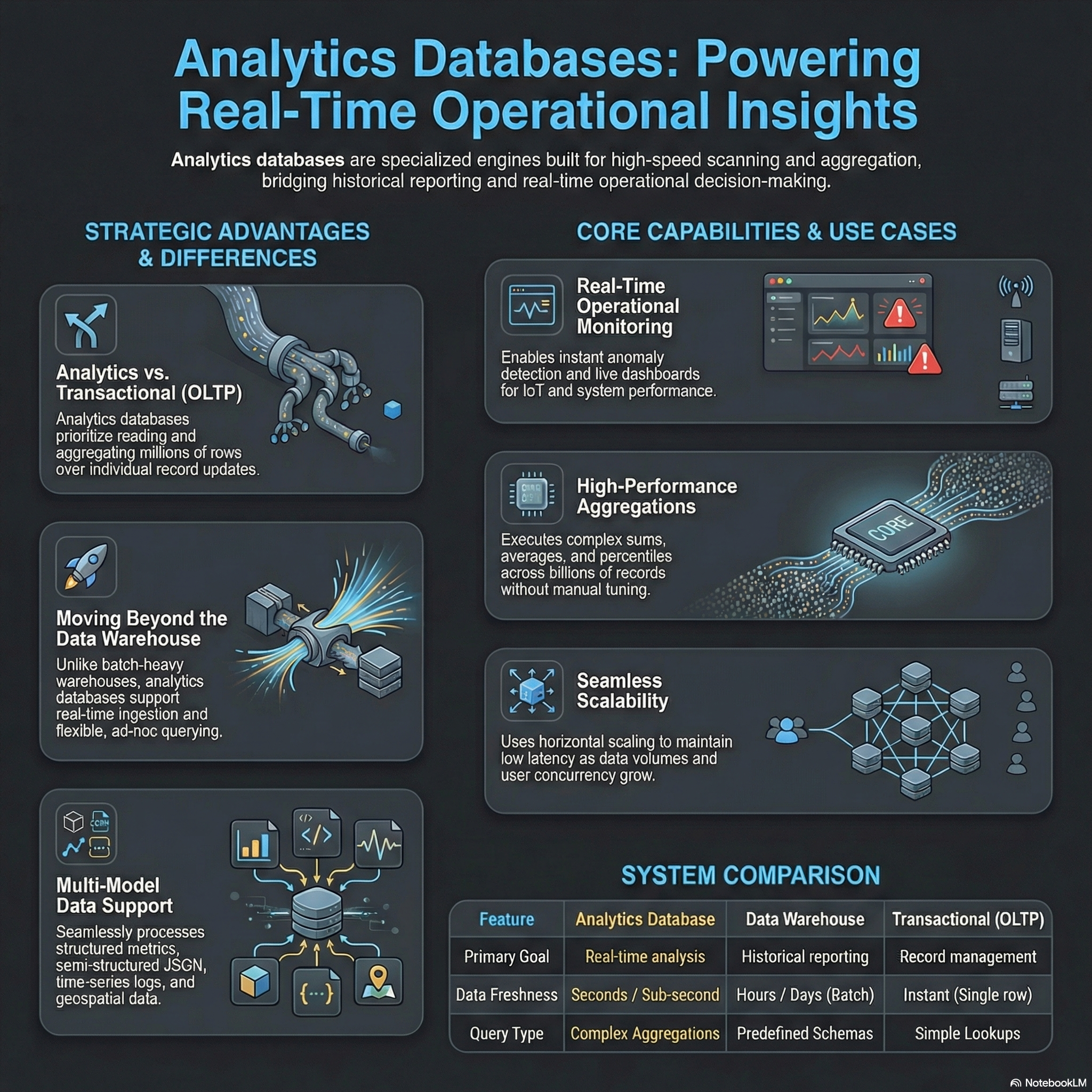
A common source of confusion is the difference between analytics databases and transactional databases. While both store data, they are built for very different workloads.
Transactional databases, often referred to as OLTP systems, are optimized for:
- High volumes of small, fast read and write operations
- Strong consistency and concurrency
- Managing day-to-day business transactions
Analytics databases, commonly associated with OLAP workloads, focus on:
- Scanning and aggregating large datasets
- Running complex queries across many rows and columns
- Supporting concurrent analytical queries from multiple users
- Delivering insights with low latency
Using a transactional database for analytics often leads to performance bottlenecks, complex workarounds, or the need to offload data into separate systems for analytics. This is why analytics databases play a distinct and increasingly critical role in modern data architectures.
Analytics Database vs Data Warehouse
Data warehouses and analytics databases are closely related but serve different roles.
Data warehouses traditionally:
- Focus on historical analysis
- Rely on batch ingestion and ETL pipelines
- Use predefined schemas and aggregations
- Prioritize reporting and business intelligence
Analytics databases:
- Often support real-time or near-real-time data ingestion
- Allow flexible querying without heavy pre-aggregation
- Are used both for dashboards and operational use cases
- Integrate directly with applications and services
Core Capabilities of an Analytics Database
Modern analytics use cases go far beyond static reports. As a result, analytics databases must support a broad and demanding set of capabilities.
High-Performance Aggregations at Scale
Analytics workloads rely heavily on aggregations such as sums, averages, percentiles, and group-by queries. A modern analytics database must execute these efficiently across millions or billions of records without requiring constant tuning.
Real-Time and Near Real-Time Analytics
The need for fresh data depends heavily on the use case. Some analytics scenarios work perfectly well with data that is updated every few hours or processed overnight, such as periodic reporting or trend analysis. Others are far more time-critical and require insights almost immediately.
For use cases like system monitoring, user behavior analysis, or operational decision making, the ability to ingest and query data within seconds becomes essential. Modern analytics databases must therefore support a range of latency requirements, from scheduled and batch analytics to near real-time and real-time insights, allowing organizations to react at the pace their business demands.
Flexible Data Models
Schema requirements in analytics vary widely depending on the use case. In some scenarios, a well defined and strict schema is essential to ensure data quality, consistency, and reliable reporting. In others, especially when dealing with fast evolving data sources or exploratory analytics, too much rigidity can slow teams down.
Analytics data often changes over time as new attributes appear, data sources multiply, or requirements evolve. In these cases, more flexible data models make it easier to adapt without frequent and complex migrations. A modern analytics database should support both approaches, allowing teams to enforce structure where it matters while remaining flexible where speed and adaptability are more important.
Support for Complex Queries
Extracting meaningful insights from data rarely involves simple lookups. Analytics workloads typically require combining data from multiple sources, filtering large datasets, and applying advanced calculations to uncover patterns and trends. Joins across tables, complex filtering conditions, nested and semi-structured fields, and advanced analytical functions are all part of everyday analytics work.
Cardinality plays a key role in how efficiently these queries can be executed. High-cardinality dimensions, such as user IDs, device identifiers, or timestamps, are common in analytical data and can significantly impact query performance. A capable analytics database must be able to handle both low- and high-cardinality data efficiently, without requiring excessive pre-aggregation or manual optimization.
A powerful and expressive SQL interface plays a central role here. SQL allows data engineers, analysts, and business users to express complex logic in a clear and familiar way. Beyond basic queries, support for aggregations, window functions, time-based operations, and geospatial or statistical functions significantly increases the depth of analysis teams can perform.
Ultimately, strong support for complex queries allows analytics teams to ask richer questions, iterate faster, and move from surface-level metrics to deeper insights without having to extract data into multiple specialized systems.
Scalability and Fault Tolerance
As data volumes grow, analytics databases must scale horizontally without sacrificing performance or reliability. Built-in resilience is critical for business-critical analytics workloads.
How Analytics Databases Fit into Modern Data Architectures
Analytics databases are no longer isolated reporting systems. They sit at the heart of modern, interconnected data platforms.
In a typical architecture, an analytics database:
- Ingests data from streaming platforms, applications, and devices
- Serves dashboards and BI tools directly
- Supports ad hoc analysis by data teams
- Feeds analytics results into downstream systems and AI models
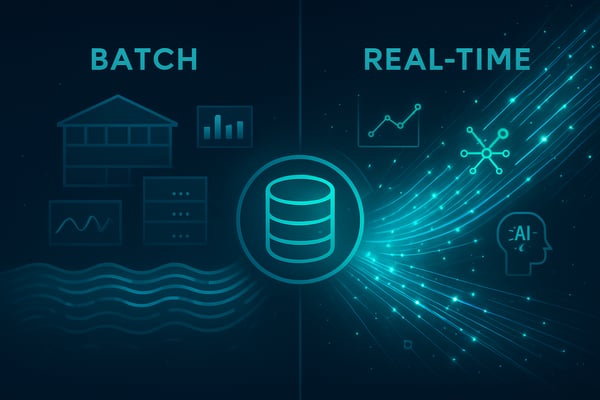
Many organizations now combine batch and streaming analytics within a single system. This reduces complexity and enables consistent insights across historical and real-time data.
As architectures move toward real-time decision making, the analytics database becomes a core operational component rather than a back-office reporting tool.
Common Use Cases for an Analytics Database
Analytics databases support a wide range of use cases, with very different requirements in terms of data freshness, query patterns, and performance. Some scenarios rely on periodic, batch-oriented analysis, while others depend on real-time or near real-time insights. A modern analytics database should be able to support both.
Batch and Periodic Analytics Use Cases
These use cases focus on analyzing historical data and do not require immediate access to newly ingested information. Data is typically processed in scheduled intervals, such as hourly, daily, or overnight.
Common examples include:
- Business reporting and KPI tracking
- Trend and historical analysis
- Financial and compliance reporting
- Capacity planning and forecasting
- Offline data science and exploratory analysis
In these scenarios, query complexity and data volume matter more than latency. The analytics database must efficiently scan large datasets, support complex aggregations, and deliver consistent results, even if the data is not completely up to date.
Real-Time and Near Real-Time Analytics Use Cases
Real-time analytics use cases require access to fresh data as soon as it arrives. Insights are used to monitor systems, guide operational decisions, or trigger automated actions.
Typical examples include:
- Real-time dashboards and operational monitoring
- User behavior and product analytics
- IoT and time-series analytics
- Anomaly detection and alerting
- Geospatial and location-based analytics
- Feeding live analytics into AI and decision systems
For these workloads, the analytics database must handle continuous data ingestion while maintaining fast query performance. Low-latency access to recent data, combined with the ability to analyze it alongside historical data, is critical.
Why Supporting Both Matters
In practice, most organizations run a mix of batch and real-time analytics. Historical analysis provides context and long-term trends, while real-time insights enable rapid response and optimization. An analytics database that supports both types of workloads reduces architectural complexity and allows teams to derive insights across time horizons using a single system.
How to Choose an Analytics Database
When evaluating an analytics database, organizations should consider:
- Query performance at scale: Can the system maintain fast response times as data grows?
- Support for high-cardinality data: Does performance degrade when analyzing granular dimensions?
- Query flexibility: Can users ask new questions without redesigning schemas or pipelines?
- Operational complexity: How much effort is required to manage, scale, and tune the system?
- Cost predictability: Are costs stable as data volume and query load increase?
- Ecosystem integration: Does the database integrate well with existing tools and workflows?
These criteria help distinguish general-purpose databases from systems truly designed for analytics workloads.
Frequently Asked Questions About Analytics Databases
CrateDB: Analytics Database for Big Workloads
CrateDB is designed specifically to address the challenges of modern analytics workloads.
As a real-time analytics database, CrateDB enables organizations to ingest high-velocity data and query it immediately using standard SQL. It supports structured and semi-structured data in a unified way, making it easier to adapt analytics as data models change.
CrateDB automatically handles indexing, distribution, and resilience, removing much of the operational complexity associated with traditional analytics databases. Its shared-nothing architecture allows it to scale horizontally while maintaining fast query performance, even under mixed read and write workloads.
This approach is particularly well suited for use cases where analytics requirements change frequently, data arrives continuously, and insights are needed without delay.
Analytics Databases and the Future of Data-Driven Decisions
Analytics databases are evolving from reporting engines into real-time decision platforms. As organizations adopt AI and automation, the ability to analyze data as it arrives becomes a strategic advantage.
The future of analytics lies in systems that combine:
- Real-time ingestion and querying
- Flexible data models
- Seamless integration with AI and operational systems
Analytics databases will increasingly power not just dashboards, but continuous intelligence that informs actions in the moment.
Conclusion
An analytics database is a foundational component of modern data platforms. By enabling fast, scalable, and flexible analysis of large and dynamic datasets, it allows organizations to move from hindsight to real-time insight.
As analytics workloads grow more complex and time-sensitive, choosing the right analytics database becomes critical. Solutions that combine performance, simplicity, and adaptability are best positioned to support the next generation of data-driven decisions.