Operational Analytics & Search
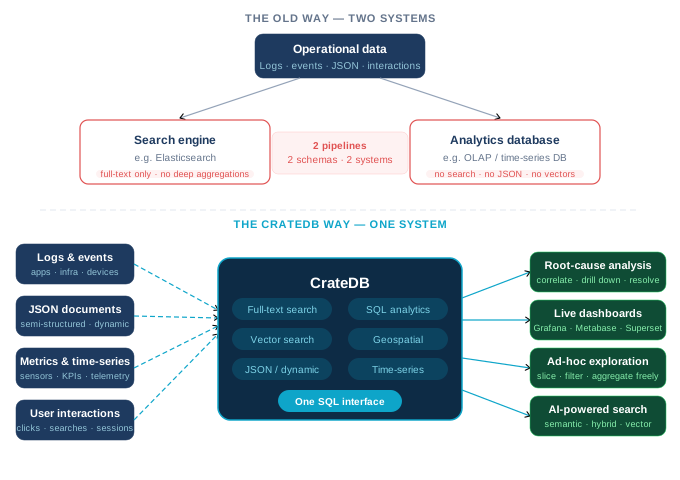
CrateDB lets organizations run analytics, search, and multi-model queries together in real time, delivering faster insights, simplified architecture, and lower costs than using multiple specialized systems.
Modern organizations generate massive volumes of logs, events, customer interactions, and operational signals. Teams need to search and analyze this data in real time, often under pressure, while systems are live.
Interactive Data Exploration
Search with Analytical Depth
Search-style queries combine with analytical aggregations, allowing users to quickly narrow down data and understand patterns across high-cardinality dimensions.
Semi-Structured Data Without Friction
Root-Cause and Troubleshooting Workflows
Why Traditional Systems Fall Short
Traditional architectures force compromises.
-
Search engines like Elasticsearch are excellent at full-text queries, but become limiting when teams need complex aggregations, joins, or multi-dimensional analytics.
-
OLAP and time-series databases handle aggregations well, but lack native support for full-text, geospatial, or vector search.
-
Multiple specialized systems introduce duplicated data pipelines, higher operational overhead, and fragmented workflows.
The result is slower root-cause analysis, higher infrastructure costs, and insights that arrive too late to act on.
User stories
"It is through the use of CrateDB that we are able to offer our large-scale video analytics component in the first place. Comparable products are either not capable of handling the large flood of data or they are simply too expensive."
Daniel Hölbling-Inzko
Senior Director of Engineering - Analytics
Bitmovin
"Thanks to CrateDB's great indexing, dedicated data types, and subsequent great performance, we could execute an event and data-driven architecture, with the performance and scalability necessary for storing time-series data over time. The SQL query syntax capability of CrateDB also played a part in achieving this great outcome, as it made it easy for the team to write good performing queries using existing know-how. CrateDB is now an integral part of our big data streaming architecture and it is delivering as promised."
Kristoffer Axelsson
Principal Solution Architect
Thomas Concrete Group
"CrateDB was a better solution for our needs than any other SQL or NoSQL database we tried. It was easy to migrate code off of our legacy SQL database and onto CrateDB to immediately benefit from its data flexibility and scalable performance."
Sheriff Mohamed
Director of Architecture
GolfNow
"I'm glad it's SQL behind those charts. If I had to use Elasticsearch to answer new questions, we wouldn't be nearly as responsive to new requirements."
Joe Hacobian
Infrastructure Engineer
Digital Domain
Additional resources
Want to know more?
FAQ
A real-time analytics database is a database system designed to process and analyze data as it is generated, providing insights and results in real-time. CrateDB excels in ingesting, indexing, storing, and querying large amounts of data within milliseconds, enabling organizations to make data-driven decisions and respond to dynamic trends quickly.
Real-time data refers to information that is gathered and processed immediately upon being generated. Examples include data from social media feeds, live customer interactions, and IoT devices. CrateDB's flexible data modeling allows for the collection and storage of a wide range of data types from diverse sources, such as enterprise applications, analytics platforms, and sensor networks.
Real-time data collection can be achieved through various methods such as streaming data ingestion, API integrations, or real-time data capture tools. CrateDB supports fast data ingestion and processing, handling millions of data points per second.
Real-time data is typically stored in databases or high-speed data stores designed to handle rapid data processing. CrateDB utilizes columnar storage to compute data aggregations on demand without downsampling or pre-aggregation, facilitating dynamic and immediate analysis of large datasets.
An example of real-time analysis could be a live dashboard displaying website visitor behavior or a system monitoring tool tracking server performance in real-time. Learn how O-CELL's real-time monitoring solution helps reduce the environmental impact with CrateDB >