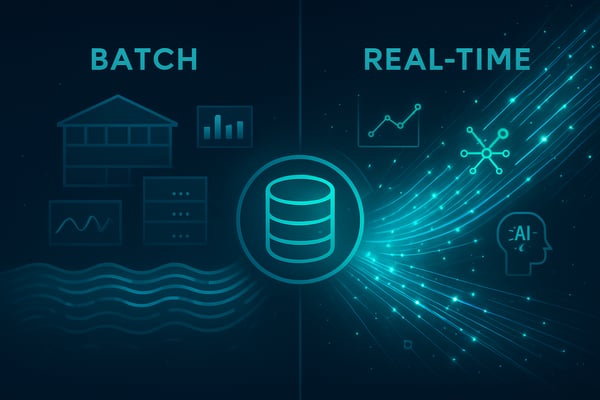
Engineering teams rarely debate whether they want real time analytics. What they debate is how many systems, pipelines, indexes, caches, and patches they’ll need to build just to get it working.
Most modern data architectures were never designed for high velocity operational workloads. As a result, engineers spend far too much time fixing around the database instead of building on top of it.
HTAP architectures aim to solve this. But only if you rethink what HTAP actually means for real world workloads today. We address in this blog post the three pain points engineers wrestle with daily, and how a unified operational analytics engine changes the equation.
What does HTAP stand for?
HTAP stands for Hybrid Transactional Analytical Processing. It describes systems that can handle two types of workloads at the same time on the same data:
- Operational workloads (traditionally called transactional): fast writes, real time event ingestion, point lookups, operational dashboards.
- Analytical workloads: aggregations, trends, joins, search, reporting, AI feature queries.
Originally, HTAP referred to databases that combined OLTP (transactional) and OLAP (analytical) capabilities in one engine.
In modern usage, especially for real time systems, it increasingly refers to unifying fast ingestion with immediate analytics, even when strict OLTP-style transactions are not required.
The Lag Between Ingestion and Insight
Even in supposedly real time stacks, there’s usually a hidden delay. Data lands in one system, gets batched or streamed into another, and becomes analytics ready only after indexing or transformation.
The result: You’re always a few steps behind what’s actually happening. For IoT, observability, or fleet operations, this delay is painful. An anomaly detected one minute too late might as well not be detected at all.
The HTAP solution: A unified engine that ingests and analyzes in the same place, with immediate indexing and distributed execution. Data becomes queryable almost instantly, eliminating the gap between event and insight.
This is where CrateDB excels: No ETL, no sync delays, no two tier architecture. Just live data, ready for analytics.
Constant Reindexing and Tuning for Evolving Workloads
Workloads shift. Formats change. Query patterns evolve. Most databases struggle here. Engineers end up:
- Creating new indexes
- Dropping old ones
- Rewriting queries
- Rebalancing clusters
- Fighting performance regressions
This tuning loop eats up time and complicates operations.
The HTAP solution: An engine that automatically indexes incoming data, distributes it efficiently, and handles both operational and analytical queries without manual tuning.
CrateDB does this by design: High velocity ingestion and complex queries coexist without engineers constantly adjusting knobs. Indexing happens in milliseconds, and the system stays fast even as data shapes evolve.
Isolating Workloads Without Duplicating Infrastructure
Mixed workloads are the Achilles heel of many systems. Heavy analytics slow down ingestion. Ingestion backlogs slow down queries.
Teams try to solve this by:
- Spinning up analytical read replicas
- Maintaining separate OLTP and OLAP clusters
- Using multiple storage layers
- Adding caches, queues, or preprocessing layers
The architecture grows, cost grows, and operational burden explodes.
The HTAP solution: A system built to handle operational and analytical queries in parallel, with native workload isolation and distributed execution.
CrateDB’s shared nothing architecture allows ingestion, search, and analytics to run without stepping on each other. One cluster, one data copy, multiple workloads. This removes layers of infrastructure and dramatically simplifies operations.
HTAP Isn’t About Transactions. It’s About Simplifying Reality.
Traditional HTAP definitions focus on OLTP plus OLAP equivalence. Real world HTAP is much simpler.
It’s about giving engineers a single system that:
- Ingests any data at high speed
- Makes it instantly queryable
- Lets analytics run on live data
- Handles structured and semi structured formats
- Scales horizontally without drama
- Eliminates unnecessary pipelines
This is the version of HTAP that modern workloads actually need. CrateDB embodies this model because it was designed from day one for operational analytics at scale, not transactional semantics.
The Bottom Line
Engineers don’t want more systems. They want fewer layers, fewer moving parts, and fewer potential problems. HTAP, redefined for today’s world, delivers exactly that. And databases like CrateDB make it possible by unifying ingestion, search, and analytics in one engine built for real time decision making.
If your architecture feels heavier each quarter, it might not be your data. It might be that your stack is doing HTAP the old way.