JSON has become the universal language of modern data. From APIs and application logs to IoT telemetry and event streams, today's systems emit massive volumes of JSON payloads every second. Storing that data is no longer the hard part.
The real challenge begins when teams try to analyze JSON data in real time. While many JSON databases excel at flexibility and document storage, they often struggle when asked to deliver fast aggregations, complex filtering, and live insights across high-volume, high-cardinality datasets.
This gap between storage and insight becomes painfully visible in real-time analytics use cases. Dashboards lag behind reality, pipelines grow more complex, and data that should drive immediate decisions ends up analyzed hours later.
In this article, we’ll explore why most JSON databases fall short for real-time analytics, what breaks at scale, and what modern systems need to turn JSON data into instant insight.
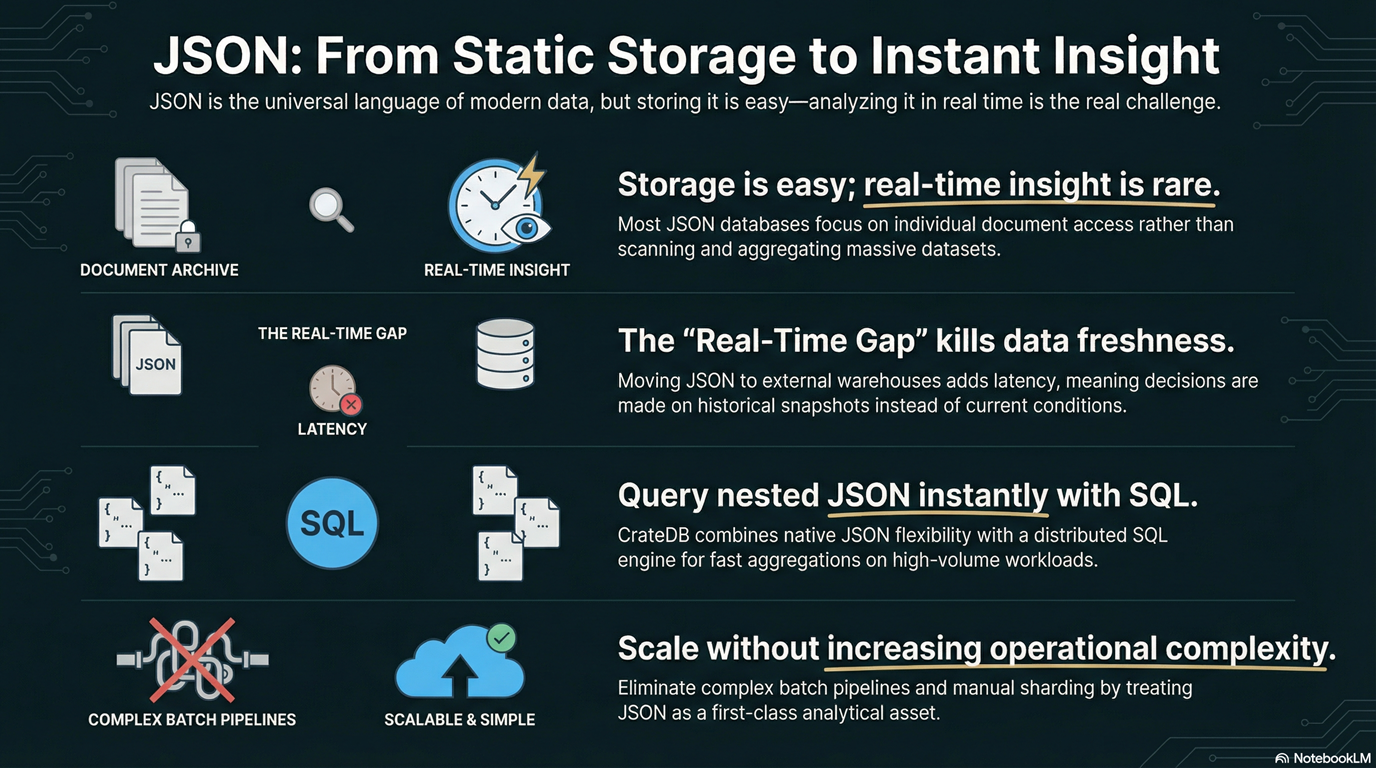
JSON Is Everywhere, but Real-Time Insight Is Rare
JSON became popular for a reason. It is:
-
Flexible
-
Human-readable
-
Well suited for evolving data structures
That makes it ideal for event data, telemetry, logs, and application payloads where schemas change frequently.
As a result, JSON databases gained traction by making it easy to ingest and store semi-structured data without rigid schemas or constant migrations. But flexibility alone does not guarantee analytical performance.
When organizations try to move from storing JSON to analyzing it in real time, they often discover that their database was never designed for that workload.
JSON Databases Were Built for Flexibility, Not Analytics
Most early JSON databases were optimized around a specific goal: document access.
They focus on:
-
Fast ingestion of individual JSON objects
-
Efficient retrieval of single documents
-
Schema flexibility at write time
Those characteristics work well for application backends and content storage. They work far less well for analytics.
Real-time analytics places very different demands on a system:
-
Scanning large volumes of data
-
Aggregating across many records
-
Filtering and grouping on nested fields
-
Handling high-cardinality dimensions like device IDs, users, or sessions
When a database is designed primarily for document retrieval, these analytical patterns become expensive and slow.
Where Traditional JSON Databases Break Down
The limitations usually surface in a few predictable areas.
Aggregations Become Bottlenecks
Nested JSON fields are not always indexed in a way that supports fast analytical queries. Aggregating across millions or billions of JSON records often leads to slow scans and unpredictable query latency.
Query Languages Limit Analytics
Many JSON databases rely on proprietary query languages. While these may be convenient for CRUD operations, they make it harder to express complex analytical queries or integrate with BI and analytics tools that expect SQL.
Scaling Adds Complexity
As data volumes grow, teams are forced to manage sharding strategies, custom indexes, and performance tuning. What starts as a flexible system quickly becomes operationally heavy.
Analytics Gets Pushed Elsewhere
To compensate, many teams export JSON data into analytical warehouses or separate systems. This adds pipelines, increases cost, and introduces latency. By the time data is analyzed, it is no longer fresh.The result is a system that stores JSON efficiently but cannot deliver timely insight.
The Real-Time Gap: When Insight Arrives Too Late
Real-time analytics depends on one critical property: freshness.
When JSON data must flow through batch pipelines or external warehouses before it can be analyzed, that freshness is lost. Dashboards lag behind reality. Alerts fire too late. Decisions are made on historical snapshots instead of current conditions.
This is especially problematic in scenarios like:
-
Operational monitoring
-
IoT and sensor analytics
-
User behavior tracking
-
Event-driven applications
In these cases, minutes or hours of delay fundamentally change the value of the data.
What Real-Time JSON Analytics Actually Requires
To analyze JSON data in real time, a system must combine flexibility with analytical strength. That means supporting more than just storage.
A real-time JSON analytics platform must provide:
-
Continuous, high-throughput ingestion
-
Immediate queryability of new data
-
Fast aggregations on nested JSON fields
-
Support for high-cardinality dimensions
-
SQL-based analytics for broad tool compatibility
-
The ability to combine structured and JSON data in the same queries
This is the difference between a JSON database that stores data and a JSON database that drives decisions.
For a deeper, neutral overview of this category, see our guide to JSON databases for real-time analytics.
From JSON Storage to Real-Time Analytics
As analytics moves closer to production systems, a new class of databases has emerged. These systems treat JSON as a first-class data type while also being designed for analytical workloads.
Instead of exporting data elsewhere, they allow teams to:
-
Ingest raw JSON streams
-
Query nested fields immediately
-
Run aggregations on fresh and historical data together
-
Eliminate batch pipelines and pre-flattening
This approach turns JSON data into a live analytical asset rather than a passive storage format.
How CrateDB Bridges the Gap
CrateDB was built specifically to address the gap between JSON flexibility and real-time analytics. It combines native JSON support with a distributed SQL analytics engine designed for high-volume, high-cardinality workloads.
By allowing teams to query nested JSON fields using standard SQL and run aggregations on data as it arrives, CrateDB enables real-time analytics directly on JSON data without complex pipelines or schema rewrites.
The result is a system where JSON is not just stored, but continuously analyzed.
For implementation details, see how JSON is handled in the CrateDB data model.
When Real-Time JSON Analytics Becomes a Competitive Advantage
Organizations that can analyze JSON data in real time gain more than just faster dashboards.
They unlock:
-
Immediate operational visibility
-
Faster incident detection and response
-
Adaptive, data-driven application
-
Real-time features for AI and automation
In these environments, the value of JSON data depends entirely on how quickly it can be understood and acted upon.
JSON Is Flexible. Insight Must Be Instant.
JSON won because it adapts to change. But in a real-time world, flexibility without speed is no longer enough.
As data volumes grow and analytics moves closer to production, teams need systems that can ingest, query, and analyze JSON data the moment it is created.
Because storing JSON is easy, turning it into real-time insight is what sets modern data platforms apart.