As data volumes grow and analytics moves closer to real-time decision making, the limitations of single-node databases become impossible to ignore. This is where the distributed database becomes a foundational component of modern data architectures.
But not all distributed databases are built for the same job. In this article, we explain why organizations adopt distributed databases, the trade-offs involved, and why real-time analytics, search, and AI workloads require a very specific type of distributed database design.
Why Companies Move to Distributed Databases
The move toward distributed databases is usually driven by very concrete pain points.
1. Data volume outgrows single machines
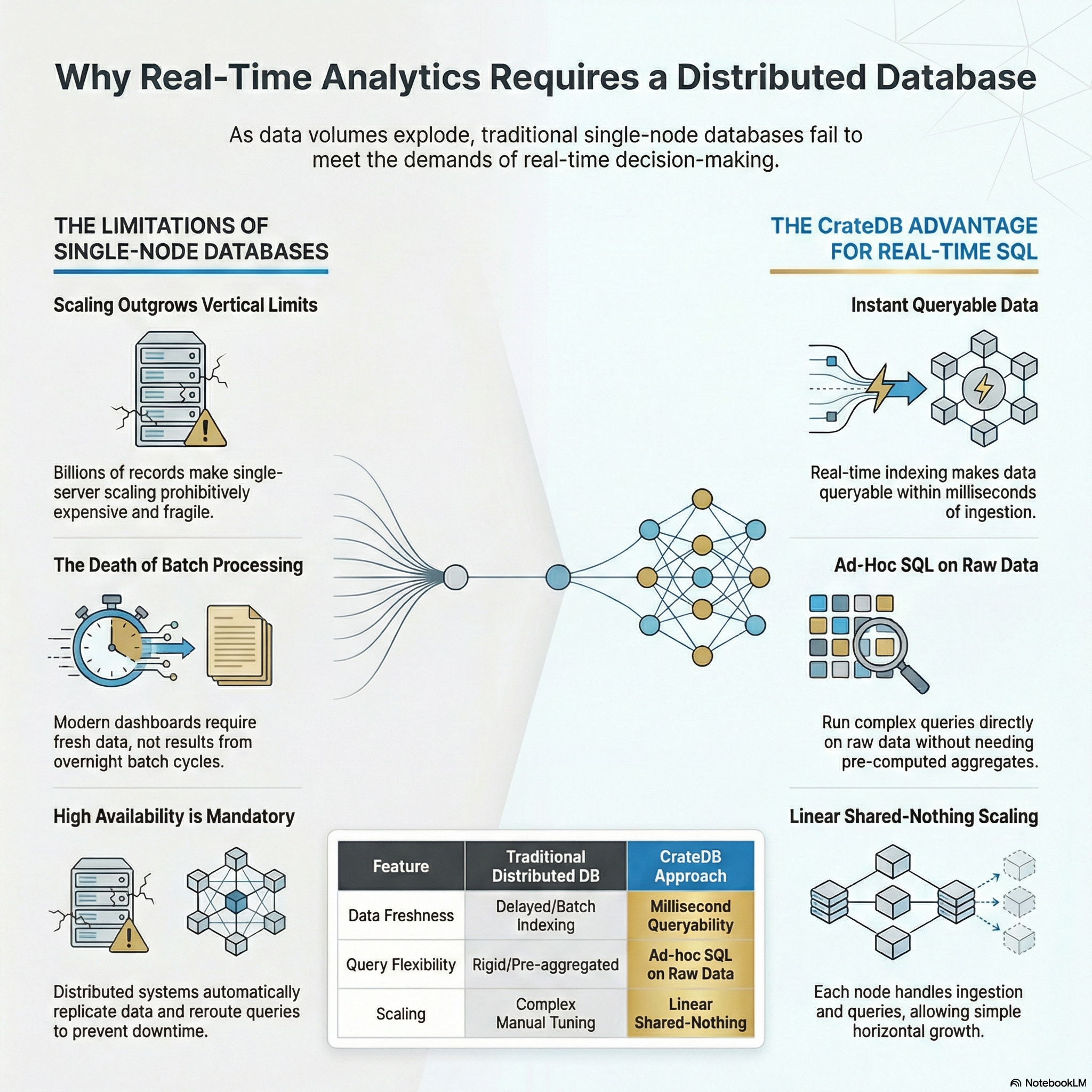
As datasets reach billions of records or high ingestion rates, vertical scaling becomes expensive and fragile. Distributed databases allow horizontal scaling by adding commodity nodes.
2. Analytics becomes operational and real time
Dashboards, monitoring systems, and user-facing analytics increasingly require fresh data and fast response times, not overnight batch processing.
3. Reliability becomes a business requirement
Downtime is no longer acceptable. Distributed databases replicate data and reroute queries automatically when failures occur.
The Hidden Trade-Offs of Distributed Databases
Distributed systems introduce complexity. Understanding these trade-offs is critical.
Network and coordination overhead: Distributing data means nodes must coordinate, replicate data, and exchange results. Poor design can turn distribution into a bottleneck instead of a benefit.
Consistency vs latency: Some systems sacrifice consistency to achieve lower latency or higher availability. Others preserve strong consistency at the cost of write or query performance.
Operational complexity: Many distributed databases require manual tuning, index planning, rebalancing, or careful data modeling to avoid performance degradation.
This is where architectural choices matter more than marketing claims.
Distributed Databases Are Not All the Same
The term "distributed database" covers very different systems:
- Distributed key-value stores optimized for simple lookups
- Distributed OLTP databases focused on transactions
- Distributed data warehouses designed for batch analytics
- Distributed SQL analytics databases built for real-time querying at scale
Each category makes different trade-offs around indexing, query execution, consistency, and data freshness.
Why Real-Time Analytics Needs a Different Kind of Distributed Database
Real-time analytics workloads are especially demanding:
- High ingestion rates from streams, events, and sensors
- Queries across large time ranges and many dimensions
- Complex aggregations, filters, and joins
- Sub-second response times for dashboards and applications
Many distributed databases struggle here because they were not designed to combine high write throughput with fast analytical queries on fresh data.
How CrateDB Approaches Distributed Databases
CrateDB takes a unique approach to distributed database architecture by designing for real-time analytics from the ground up.
Shared-nothing, scale-out architecture: CrateDB distributes data and queries across nodes using a shared-nothing design. Each node can ingest, index, and query data, allowing linear scaling for both writes and reads.
SQL without pre-aggregation: Unlike systems that require pre-computed aggregates or rigid schemas, CrateDB supports ad-hoc SQL queries directly on raw data, even at high cardinality and large scale.
Real-time indexing: Data becomes queryable within milliseconds of ingestion. There is no batch window or delayed indexing step, which is critical for operational analytics and monitoring use cases.
Built-in resilience: Replication and automatic shard reallocation ensure that failures do not interrupt queries or ingestion, without manual intervention.
Distributed SQL: The Best of Both Worlds
One of the biggest challenges with distributed databases is usability. CrateDB is a distributed SQL database, which means:
- Familiar SQL for analytics teams and engineers
- Parallel query execution across the cluster
- No need to trade expressiveness for scalability
This combination allows teams to build real-time analytics systems without introducing a complex, multi-engine architecture.
When a Distributed Database Like CrateDB Is the Right Choice
CrateDB is particularly well suited for:
- Real-time dashboards and monitoring
- Time-series and event analytics
- Multi-tenant SaaS analytics backends
- Industrial IoT and sensor data platforms
- Search and analytics on semi-structured data
If your workload requires fast analytics on continuously arriving data, a general-purpose distributed database is often not enough.
Final Thoughts: Distributed Is a Means, Not the Goal
A distributed database is not valuable because it is distributed. It is valuable when distribution enables speed, scale, and reliability without sacrificing simplicity. For real-time analytics workloads, the difference lies in whether the system was designed for analytics first or adapted later. CrateDB belongs to the first category.
Want to know more about CrateDB's infrastructure? Visit the CrateDB's distributed database architecture page.