Skip to content
Logistics · Warehouse · Automation

Your AI Features Depend on
Multiple Separate Databases Staying in Sync

CrateDB stores telemetry, maintenance documents, metadata and vector embeddings in one engine. One SQL query joins all of them on data that just arrived.

Multiple databases. Multiple failure modes. One AI feature

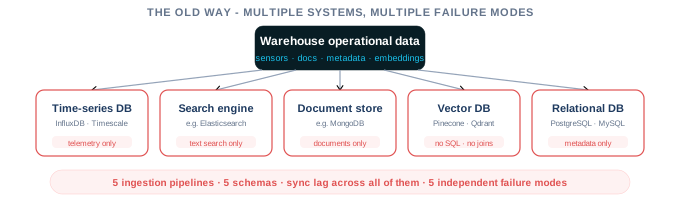
The typical stack for AI on warehouse operations: a time-series database for telemetry, a search engine for maintenance logs, a vector store for embeddings, and a relational database for SLA metadata.

Build a RAG-based Q&A feature on top — "Why did Robot 14 go offline at 02:47?" — and your query has to span four systems in the time it takes a technician to ask the question.

The synchronization lag between those systems is not a bug you can fix. It is a structural cost of the multi-database architecture.

Where traditional systems fall short

  • Synchronization lag: Every change — a new device type, an updated manual, a revised SLA threshold — must propagate across systems before it is queryable. That lag is structural, not fixable.
  • Four query interfaces: A RAG feature that spans telemetry, search, embeddings, and relational metadata requires four separate queries stitched together in application code.
  • Four failure modes: Each pipeline is its own operational surface. Ingestion failures, version drift, and schema changes in one system ripple unpredictably into the others.

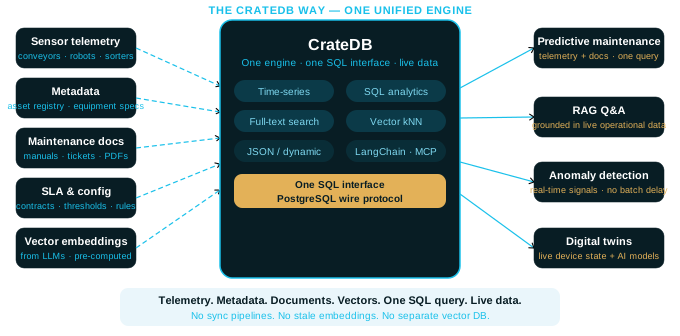
One engine for telemetry, documents, metadata, and AI queries

CrateDB AI-ready analytics diagram

One engine, all data types

CrateDB stores time-series telemetry, JSON documents, metadata, and vector embeddings as first-class citizens — not bolt-on features, not a federated layer over separate stores.

No synchronization pipelines

When a maintenance manual is updated, the AI can retrieve it immediately. No ETL job, no lag, no separate operational overhead for a vector store that has to stay current with your telemetry.
cr-quote-image

Standard SQL with AI primitives

A single SQL query joins telemetry, documents, and embeddings on data that arrived seconds ago. No custom query language, no new operators to learn.
cr-quote-image

Works with your AI stack
LangChain, LlamaIndex, and Python-based AI pipelines connect via the PostgreSQL wire protocol. No custom connectors, no new drivers.
cr-quote-image

RAG on live operational data. In standard SQL.

Standard SQL. No proprietary functions. No pre-aggregation. The data is live.


SELECT
t.device_id,
t.error_code,
d.manual_section,
knn_match(d.embedding, :query_embedding, 5) AS relevance_score
FROM
telemetry t
JOIN
equipment_docs d ON t.device_id = d.device_id
WHERE
t.timestamp > NOW() - INTERVAL '30 minutes'
AND t.value > t.sla_threshold
ORDER BY
relevance_score DESC
LIMIT
10;
<


See it for yourself in under 30 minutes.

Examples of large workloads in production

ABB Ability™ Genix optimizes operations and increases asset availability in industrial use cases by analyzing vast amounts of data in real-time. They use CrateDB to unlock the value of industrial data, working with advanced data analysis and data management capabilities. With a data ingestion rate of an 1 million values per second and event retrieval ranging from 30,000 to 120,000 events per second, ABB optimizes industrial efficiency and productivity.

"Working with CrateDB brings positive outcomes. The ingestion and throughput have very good performance, with 1 million values/sec, the horizontal scalability where we can add as many nodes as we need and the automatic query distribution across the whole cluster"

Marko Sommarberg
Lead, Digital Strategy and Business Development at ABB

cr-customers-abb
Qualtrics is the leader in experience management software. They use CrateDB to process open text survey responses and enable machine learning algorithms to be applied to the data to make it easier to gain insights from thousands of pieces of feedback per hour.
"CrateDB gives us ease of SQL combined with easy scaling, and real-time querying of full-text data."
Qualtrics
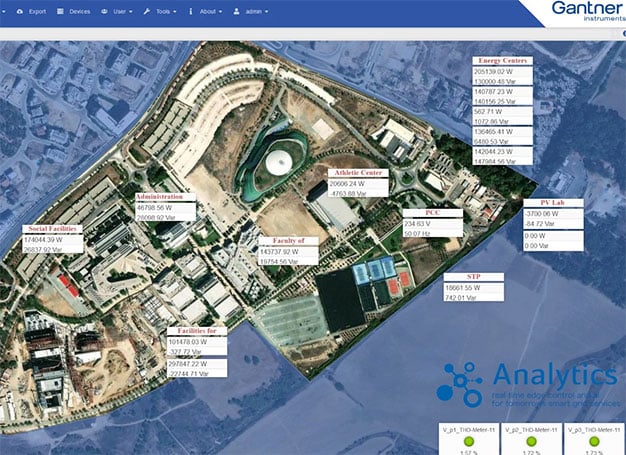
Gantner Instruments collaborates with the University of Cyprus to operate a state-of-the-art Smart Micro Grid, dedicated to investigating the control capabilities of renewable energy sources in the power grid and propelling the energy transition forward. They leverage CrateDB to analyze the vast amount of data generated in real time, enhancing their processes through machine learning (ML). With CrateDB, they gain access to their extensive data within microseconds at the frontend, ensuring optimal performance.

"CrateDB is the only database that gives us the speed, scalability and ease of use to collect and aggregate measurements from hundreds of thousands of industrial sensors for real-time visibility into power, temperature, pressure, speed and torque."

Jürgen Sutterlüti
Vice President, Energy Segment and Marketing at Gantner Instruments.

cr-customers-gantner

Resources

Talk
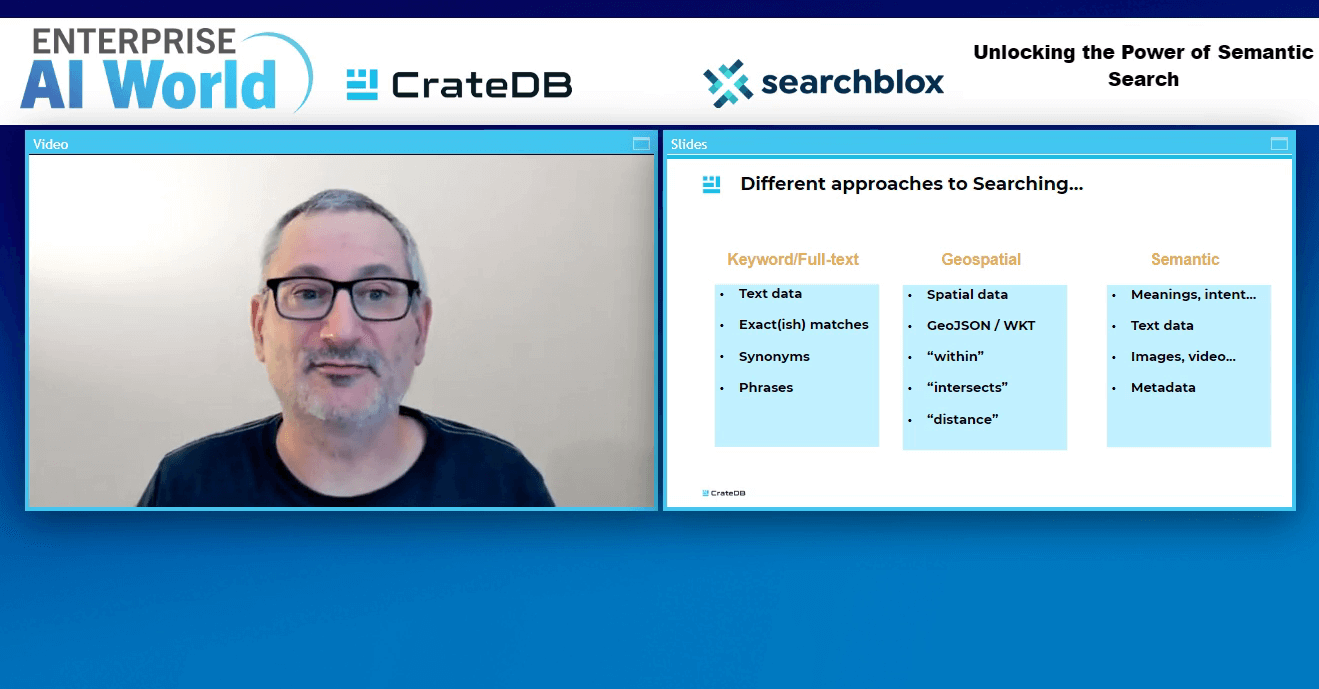
Unlocking the Power of Semantic Search

Unlock the power of semantic search by watching this ingsightful webinar where Simon Prickett, Senior Product Evangelist CrateDB, highlights CrateDB's ability to integrate various data types (text, geospatial, vectors) for hybrid search using SQL, enabling faster, more contextually relevant results.

Webinar
From-Documents-to-Dialogue-Unlocking-PDF-Data-with-a-Smart-Chatbot
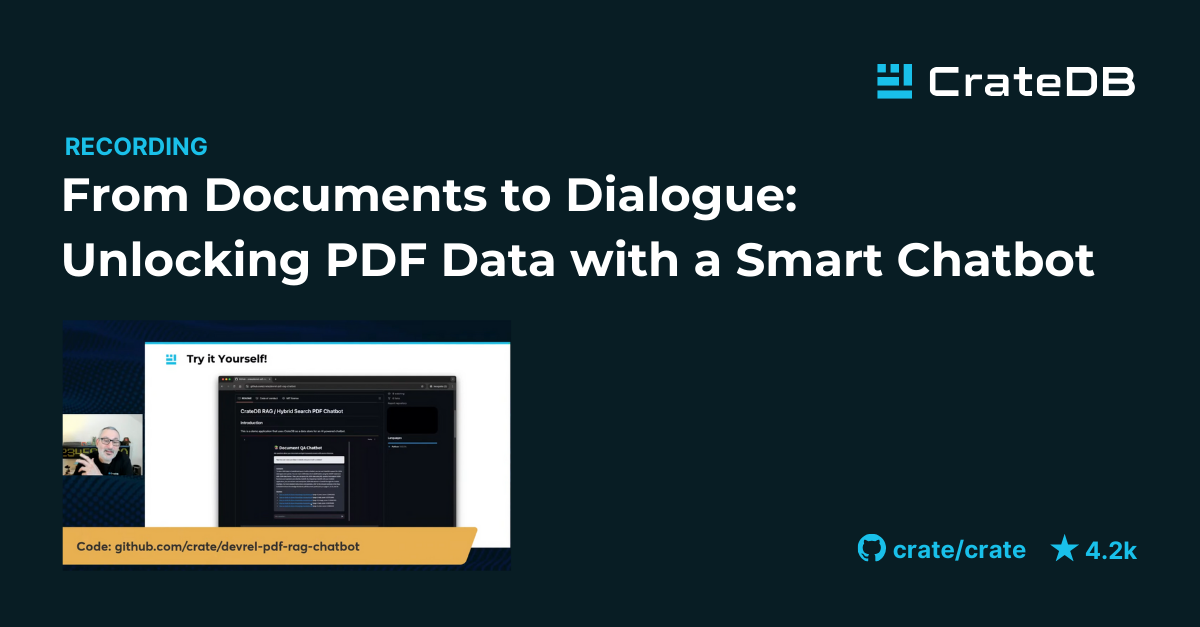
From Documents to Dialogue: Unlocking PDF Data with a Smart Chatbot

In this webinar recording Simon Prickett reveals how to unlock text and image data trapped in PDF files and search it using the power of AI and CrateDB.

Website
semantic search
Vector search with CrateDB

CrateDB maximizes the potential of vector data with a single, scalable database that can be queried with SQL and streamlines data management, significantly reducing development time and total cost of ownership.

Documentation
icon_documentation
Search

Based on Apache Lucene, CrateDB offers native BM25 term search and vector search, all using SQL. By combining it, also using SQL, you can implement powerful single-query hybrid search.

Webinar
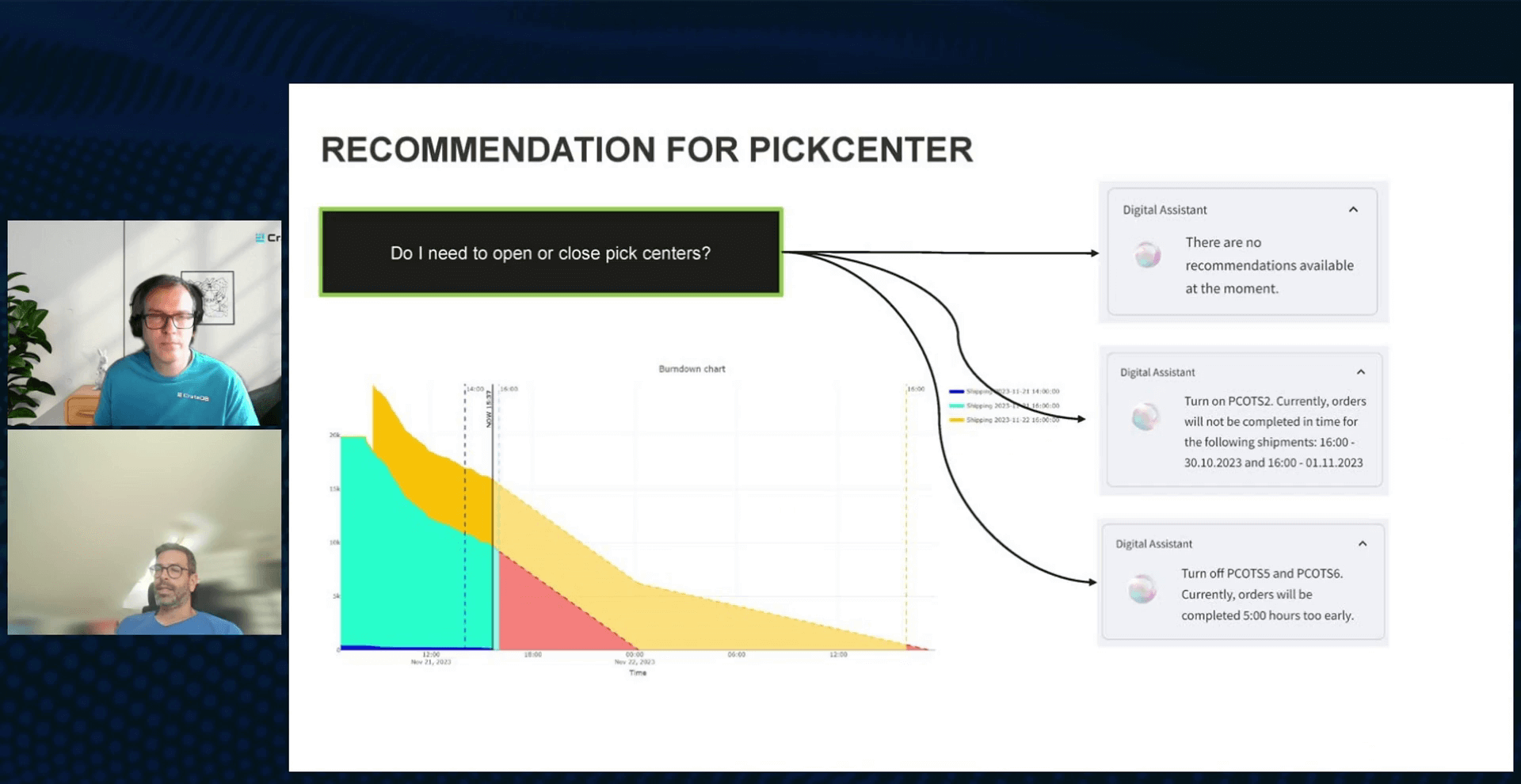
Recommendation for Pickcenter
Faster Fixes, Better Outcomes: How AI Empowers Operators on the Shop Floor

In this webinar recording, TGW Logistics shows you how combining digital twins with generative AI can help you solve real-world operational challenges—like reducing downtime, streamlining maintenance, and empowering your teams with instant access to the knowledge they need. 

White Paper
DATA ENGINEERING ESSENTIALS FOR THE AI ERA
Data Engineering Essentials for the AI era

Download this report to discover how to build a future-proof data backbone for real-time AI success. 

Webinar
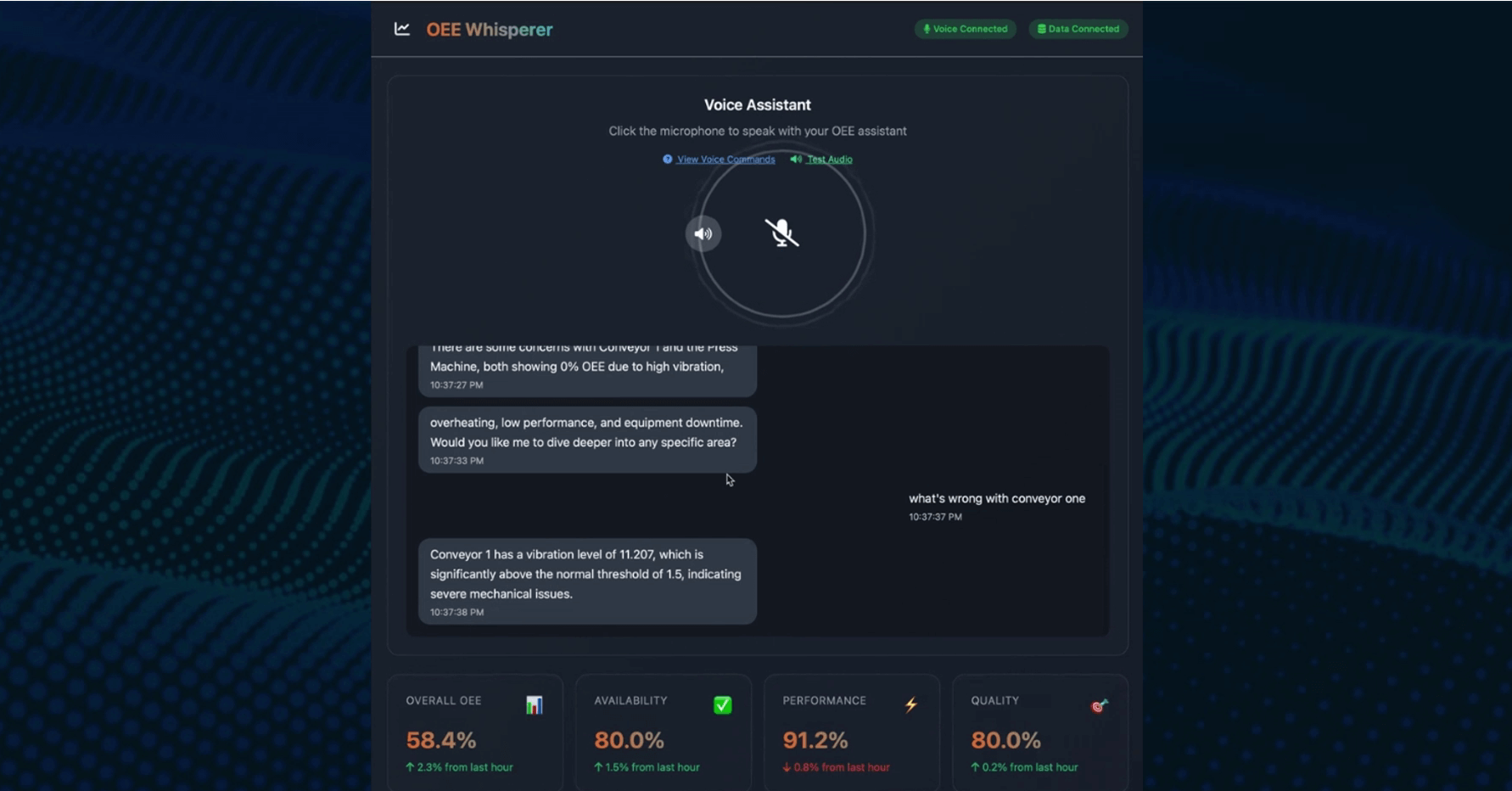
The OEE Whisperer Demo
The OEE Whisperer

Meet “The OEE Whisperer” – a groundbreaking AI-powered voice assistant built to transform your factory floor. Speak to your factory in plain language and get real-time, predictive insights instantly. 

Ebook
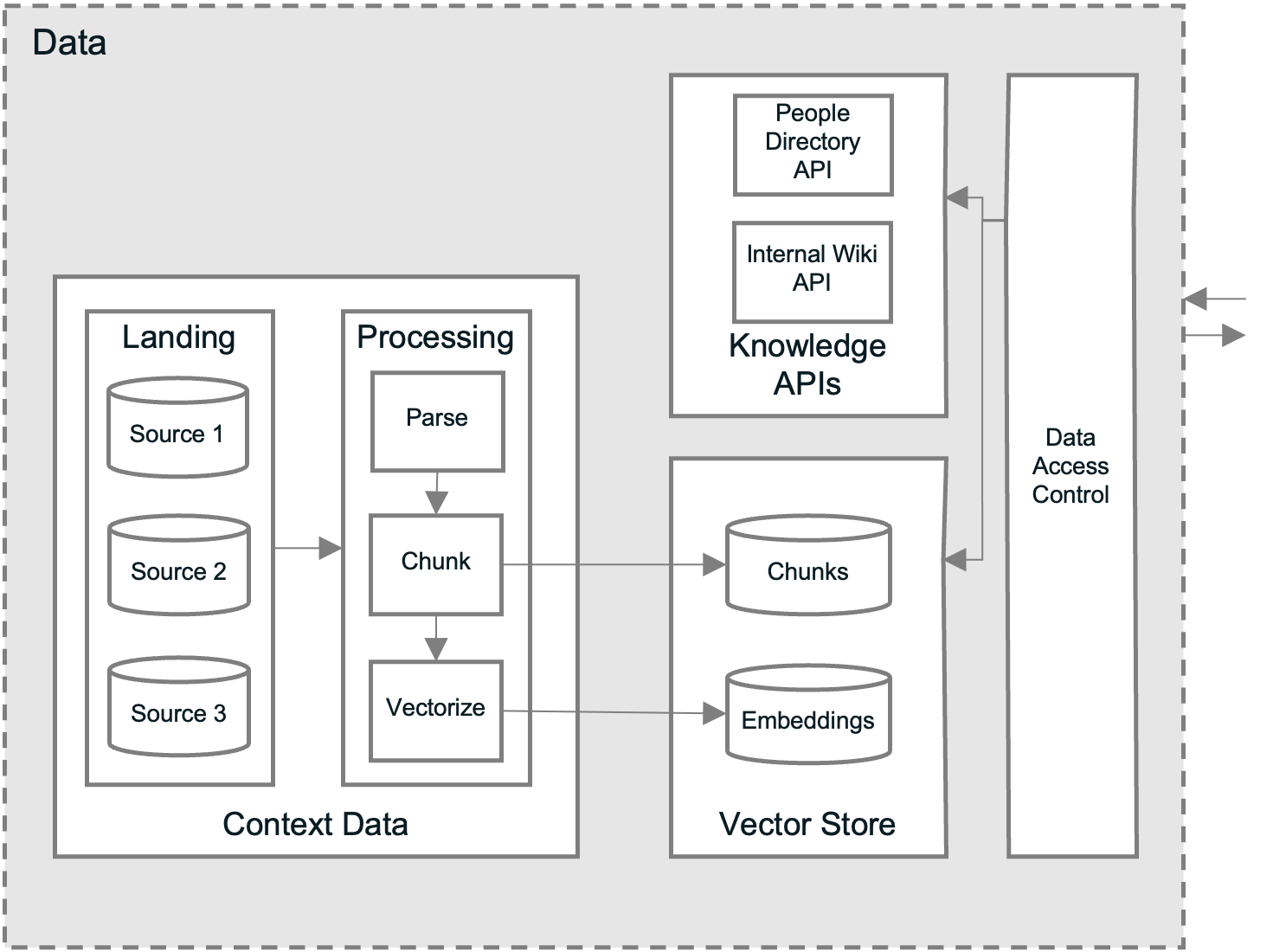
Context Data
Unlocking the Power of Knowledge Assistants with CrateDB

As a cutting-edge real-time analytics database, CrateDB provides the foundation for building chatbots and knowledge assistants that are not only fast and reliable but also intelligent and scalable. 

Demo
Building-an-AI-Chatbot-with-CrateDB-and-LangChain-play
Building an AI Chatbot with CrateDB and LangChain

This video shows step by step how to build an AI-powered chatbot using LangChain to connect to the different LLMs and CrateDB to store embeddings and run similarity searches against them.

See it for yourself in under 30 minutes.

FAQ

Vector search finds results based on semantic similarity rather than exact matches, comparing vector embeddings that capture the meaning of data (e.g., text, documents, images, videos).

CrateDB supports vector embeddings natively and allows similarity queries (e.g. k-nearest neighbors), combined with filters, aggregations, and full-text or time-series data, all in SQL.

Full-text or keyword search (e.g. BM25) matches exact or approximate lexical similarity (words, phrases). Vector search matches semantic similarity (e.g. meaning, context, concepts, embeddings). CrateDB allows hybrid search, combining vector and full-text search in the same query.

Yes. CrateDB is built to scale: high ingestion rates, storage of structured + vector + unstructured data, and efficient querying even with large embedding volumes.

CrateDB’s value proposition is to unify these: instead of separate vector stores, search engines, and analytics/OLAP systems, you can do embeddings + filtering + aggregations + full-text + search in one system. This reduces latency, complexity, and operational overhead.

Examples include: semantic search over documents, recommendation systems (matching embeddings), anomaly detection in real time, combining text search + vector similarity (hybrid search), powering chatbots or AI features that need fast access to embeddings + metadata + analytics together. 

RAG Pipelines, short for Retrieval Augmented Generation Pipelines, are a crucial component of generative AI, that combines the vast knowledge of large language models (LLMs) with the specific context of your private data.

A RAG Pipeline works by breaking down your data (text, PDFs, images, etc.) into smaller chunks, creating a unique "fingerprint" for each chunk called an embedding, and storing these embeddings in a database. When you ask a question, the system identifies the most relevant chunks based on your query and feeds this information to the LLM, ensuring accurate and context-aware answers. They operate through a streamlined process involving data preparation, data retrieval, and response generation.

  1. Phase 1: Data Preparation
    During the data preparation phase, raw data such as text, audio, etc., is extracted and divided into smaller chunks. These chunks are then translated into embeddings and stored in a vector database. It is important to store the chunks and their metadata together with the embeddings in order to reference back to the actual source of information in the retrieval phase.

  2. Phase 2: Data Retrieval
    The retrieval phase is initiated by a user prompt or question. An embedding of this prompt is created and used to search for the most similar pieces of content in the vector database. The relevant data extracted from the source data is used as context, along with the original question, for the Large Language Model (LLM) to generate a response.
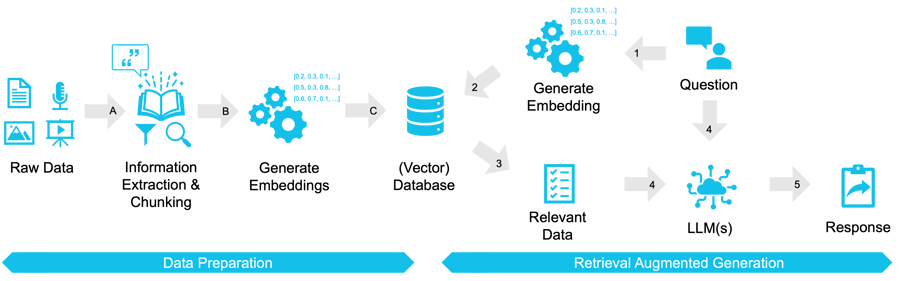

Retrieval augmented generation (RAG) Pipeline

While this is a simplified representation of the process, the real-world implementation involves more intricate steps. Questions such as how to properly chunk and extract information from sources like PDF files or documentation and how to define and measure relevance for re-ranking results are part of broader considerations.