What Is an IoT Database?
An IoT database is a database system built to handle continuous data streams generated by connected devices. Unlike traditional databases, it is optimized for workloads where data arrives constantly, queries must run on fresh data, and analytics must scale across millions of devices and dimensions.
An IoT database typically supports:
-
Continuous, high-throughput data ingestion
-
Time-series and event-based data models
-
High-cardinality attributes such as device IDs, locations, and firmware versions
-
Real-time and historical analytics in the same system
IoT databases power operational dashboards, monitoring platforms, and data-driven applications where insight must be available seconds after data is produced.

Why Traditional Databases Are Not Designed for IoT
IoT workloads introduce characteristics that many general-purpose databases were not built to handle.
-
Transactional databases prioritize individual record updates, not sustained ingestion and large analytical scans.
-
Time-series databases focus on append-only metrics and often struggle with high-cardinality, multi-dimensional queries
-
Data warehouses rely on batch ingestion pipelines that introduce latency and operational overhead
As IoT systems scale, these limitations make it difficult to analyze fresh device data quickly and consistently, especially as analytical requirements evolve.
An IoT database differs from time-series databases and data warehouses by combining high-throughput ingestion with real-time, SQL-based analytics in a single system.
Core Requirements of an IoT Database
A production-grade IoT database must support the full lifecycle of IoT analytics without constant tuning or architectural workarounds.
Key requirements include:
-
Continuous high-throughput data ingestion
-
Real-time queries on fresh and historical data
-
Efficient handling of high-cardinality dimensions
-
Horizontal scalability as device fleets grow
-
SQL-based analytics for flexibility and accessibility
-
Built-in resilience and fault tolerance
Meeting these requirements in a single system is critical as IoT analytics moves closer to operational and customer-facing applications.
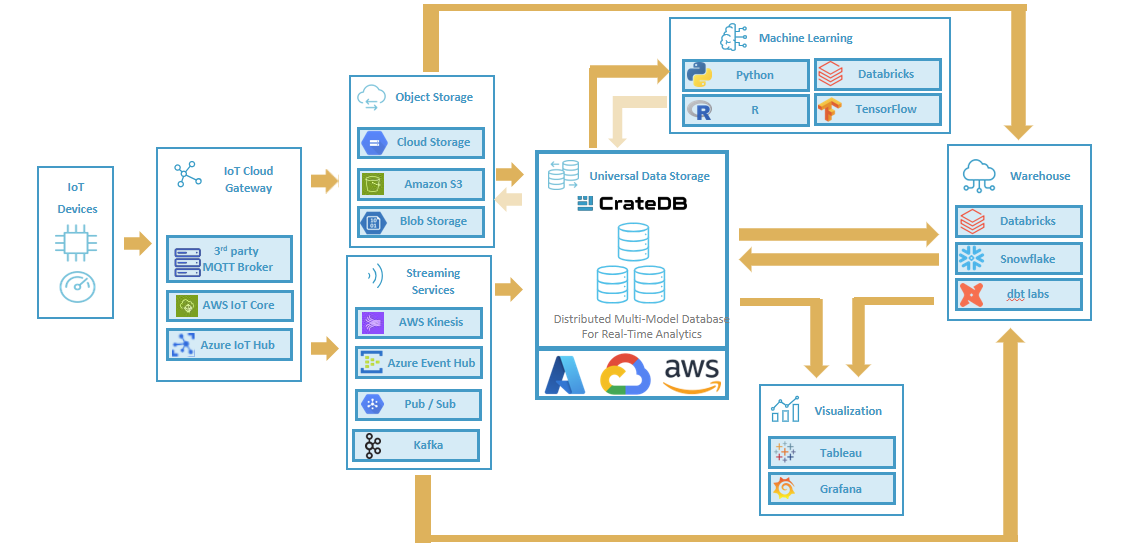
High-Velocity IoT Ingestion with Immediate Query Access
IoT systems generate continuous streams of sensor values, logs, and device events. An IoT database must ingest this data at high speed and make it available for querying immediately.
CrateDB captures IoT data as it arrives and indexes it automatically, enabling real-time queries without manual tuning or batch processing. Data remains query-ready from the moment it is ingested, allowing applications and dashboards to operate on live data with minimal latency.
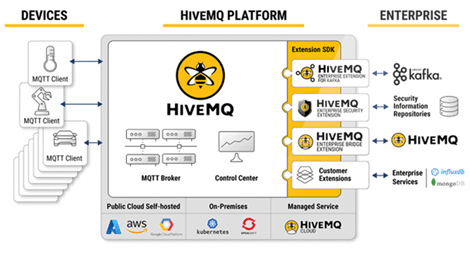
This ingestion model supports modern IoT architectures built on streaming platforms, connectors, and direct application integrations.
Distributed SQL for Real-Time and Historical IoT Analytics
IoT analytics rarely stops at simple metrics. Teams need to combine time-series data with device metadata, customer context, and operational attributes.
CrateDB distributes SQL queries across the cluster, enabling fast analytics on large volumes of IoT data. Using SQL, teams can:
-
Join telemetry with device and asset metadata
-
Run window functions and time-based analysis
-
Perform real-time aggregations on fresh data
-
Analyze long-term historical datasets
-
Execute ad hoc queries without pre-aggregation
This unified analytical model supports dashboards, anomaly detection workflows, alerting systems, and predictive analytics directly on IoT data.
Multi-Model Data Support for Complex IoT Payloads
IoT payloads are rarely uniform. Devices may emit structured metrics, nested JSON objects, location data, logs, or AI features, often within the same system.
An IoT database must handle this diversity without forcing teams to manage multiple specialized engines.
CrateDB supports multiple data models within a single database:
All data types are accessible through SQL, enabling flexible analytics across heterogeneous IoT datasets.
Designed for Industrial, Hybrid, and Edge Environments
IoT systems operate across diverse environments, from centralized cloud platforms to factories, vehicles, and remote locations.
CrateDB adapts to these architectures by supporting cloud, on-premise, hybrid, and edge deployments with the same core capabilities. Lightweight edge nodes enable local data processing, while synchronization with central clusters supports global analytics and coordination.
This flexibility makes CrateDB well suited for industrial IoT, fleet operations, utilities, energy systems, and distributed sensor networks.
Geospatial and Mobility Analytics at Scale
Many IoT platforms track mobile or location-aware devices. Geospatial analytics is therefore a core requirement, not an add-on.
CrateDB includes native geospatial support that enables real-time and large-scale location analytics, including:
-
Geofencing and proximity analysis
-
Location-based aggregations
-
Fleet and asset movement analysis
-
Operational zone and coverage monitoring
These capabilities allow teams to analyze mobility patterns and spatial behavior directly within the IoT database.
Search and AI-Ready Analytics for IoT Data
IoT data often includes logs, metadata, and signals that benefit from search or AI-powered analysis. Adding separate search or vector engines increases complexity and latency.
CrateDB integrates full-text search and vector search directly into SQL, enabling:
-
Text search on logs and metadata
-
Similarity search on vector embeddings
-
Real-time feature extraction
-
Unified storage for sensors, logs, and AI features
This makes it possible to build predictive maintenance, anomaly detection, and digital twin systems without introducing additional data platforms.
Reliability and Security for Connected Systems
IoT platforms require continuous operation and strong protection for device and operational data.
CrateDB is built on a shared-nothing architecture with automatic replication and fault tolerance. It supports encryption at rest, TLS for data in transit, and role-based access control. CrateDB Cloud is certified under ISO 27001 and SOC 2 standards.
These capabilities support both production reliability and compliance requirements in connected environments.
Digital Twins and Contextualized IoT Analytics
Digital twins require more than raw telemetry. They rely on metadata that describes physical entities, data sources, quality constraints, and modeling assumptions.
CrateDB provides a unified repository for storing and retrieving digital twin metadata alongside time-series data. This enables real-time contextualization of telemetry and seamless transitions between technical and business views.
By integrating analytics and AI technologies directly on this data, teams can run complex algorithms, machine learning models, and statistical analysis without moving data between systems.
Open Source IoT Database with Flexible Deployment Options
CrateDB’s open source licensing model reduces infrastructure costs and benefits from an active community.
Whether you choose a fully managed cloud service or a self-managed deployment, CrateDB provides a flexible foundation for building fast, scalable IoT analytics systems.
When to Use CrateDB as your IoT Database
CrateDB is a strong fit when your IoT workloads involve:
-
High volumes of continuously ingested device data
-
High-cardinality identifiers and dimensions
-
Real-time analytics requirements
-
Operational dashboards and customer-facing applications
-
The need to simplify data architecture while scaling
By unifying ingestion, analytics, search, and AI readiness in a single system, CrateDB enables faster insights with lower architectural complexity.